
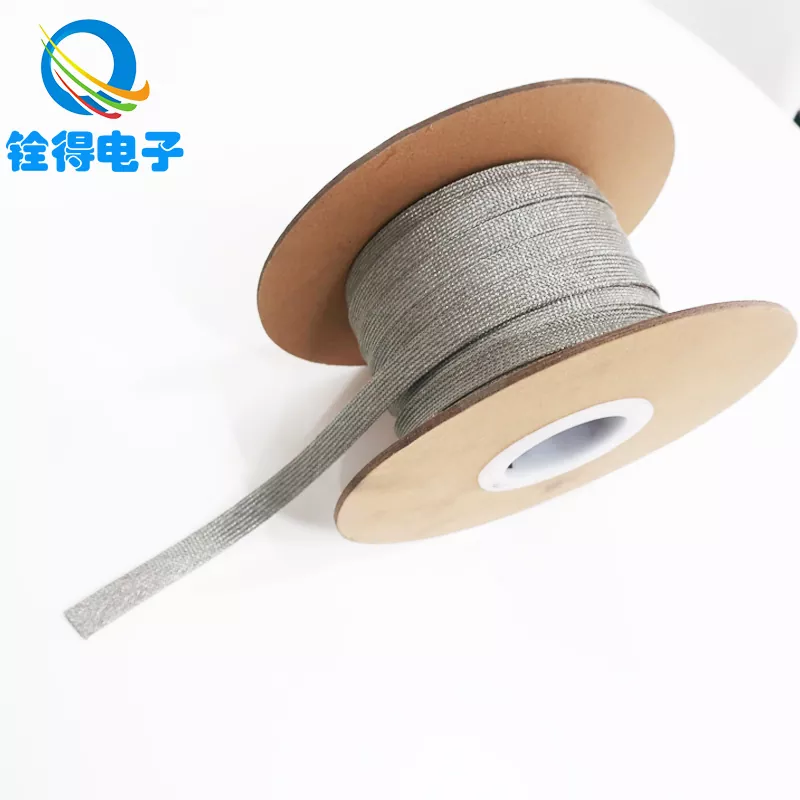
43mm Copper Foil Wire Braided Mesh Tube
When selecting shielding solutions for complex electronic systems, the choice of braided mesh tube diameter directly affects installation ease and performance. Our copper foil wire braided mesh tubes are engineered for reliable EMI protection across a range of cable diameters. For applications that demand a slightly smaller internal clearance, the 41mm Copper Foil Wire Braided Mesh Tube provides a firm grip on compact harnesses. Moving up incrementally, the 42mm Copper Foil Wire Braided Mesh Tube suits mid-range bundling without adding bulk. When the cable assembly expands beyond standard dimensions, stepping to the 44mm Copper Foil Wire Braided Mesh Tube or the 45mm Copper Foil Wire Braided Mesh Tube accommodates thicker looms commonly found in power distribution and industrial machinery. Each variant is woven from high-purity copper foil strips and tinned copper wire to form a flexible, conductive jacket. The braided construction ensures low-resistance contact across the entire surface, effectively suppressing radiated emissions from several kHz up to GHz frequencies. The open weave also promotes heat dissipation and allows visual inspection of underlying cables. These tubes resist oxidation and maintain spring-like recovery after repeated flexing, making them suitable for robotics, protective conduits, and expansion joints. Their seamless integration with standard grounding clamps and connectors simplifies retrofitting into existing enclosures. Typical uses include shielding for data transmission lines, dynamic grounding straps, and vibration damping in automotive sensor harnesses. The combination of lightweight design and high tensile strength reduces strain on connectors while preserving signal integrity.
The 43mm Copper Foil Wire Braided Mesh Tube occupies a versatile middle ground, offering ample room for cable bundles common in power inverters, EV charging harnesses, and server rack interconnects. This specific diameter balances compactness with generous internal volume, allowing it to slide over irregularly shaped connectors without excessive snagging. Its weave density is optimized to deliver over 75 dB of shielding attenuation at 100 MHz, while still maintaining a flexural modulus that eases installation around corners. Below is a detailed breakdown of its key specifications.
- Inner diameter: 43 mm ± 1 mm (uncompressed)
- Outer diameter: 47 mm ± 1 mm nominal
- Construction: Tubular braid, copper foil over tinned copper wire carrier
- Foil width: 2.5 mm, thickness 0.12 mm
- Wire diameter: 0.15 mm, tinned copper, 8 carriers per strand
- Braiding angle: 45° ± 3°, providing balanced longitudinal and radial strength
- Surface finish: Bright, untreated copper; optional tin-dipped coating available
- Operating temperature range: -40 °C to +150 °C, intermittent up to +200 °C
- DC resistance: ≤ 5 mΩ/m at 20 °C
- Shielding effectiveness: ≥ 70 dB from 30 MHz to 1 GHz, ≥ 55 dB at 10 GHz (per MIL-STD-285)
- Flammability rating: Self-extinguishing, meets UL 94 V-0 criteria when end-sealed with appropriate ferrule
- Standard supply length: 25-meter rolls, custom cut lengths available
| Mechanical Property | Value |
|---|---|
| Ultimate tensile strength (braid) | 320 N (axial pull on 100 mm gauge) |
| Elongation at break (braid) | 22% |
| Bend radius (dynamic) | ≥ 95 mm |
| Abrasion resistance | Excellent, retains conductivity after 5000 cycles under 5 N load |
| Environmental Resistance | Performance |
|---|---|
| Salt spray (ISO 9227) | ≥ 240 hours without red rust on tinned wire; bare copper shows superficial tarnish after 72 hours but no electrical degradation |
| UV exposure (ASTM G154) | No cracking or loss of flexibility after 1000 hours |
| Chemical resistance | Unaffected by most hydraulic oils, diesel fuel, and weak acids; avoid prolonged contact with ammonia-based cleaners |
Installation of the 43mm Copper Foil Wire Braided Mesh Tube is straightforward: the braid expands slightly when compressed longitudinally and contracts when pulled, allowing easy routing over connectors. Its cut ends can be terminated with standard copper ferrules or crimp sleeves to prevent fraying. The tube’s high coverage factor—typically above 92%—minimizes leakage gaps while preserving enough openness for air circulation. Field technicians appreciate the balance between stiffness and pliability, which holds the tube in place after forming but permits hand bending without tools. For systems where multiple diameter transitions are necessary, the 43mm version serves as an intermediate sleeve that can be mated with smaller or larger diameters using conductive tape or clamp adapters. Its consistent wall thickness and roundness contribute to repeatable impedance paths in ground-loop applications. This product is fully compliant with RoHS and REACH directives, and material certificates are available upon request. Stocks are maintained in North American and European warehouses, enabling next-day dispatch for most standard roll lengths.
Related Products


Hot Products

3.5MM Solder Wick Braid Wire
The 3.5MM Solder Wick Braid Wire is a tool used to remove excess solder from electronic components such as circuit boards. The tin-absorbing copper braid is mainly woven from copper wire. The pure copper tin-absorbing copper braid has good electrical and thermal conductivity, and can quickly transfer heat to melt and absorb the solder. Quande Electronics keeps up with the latest development trends and cutting-edge technologies in the professional field, constantly updates knowledge and skills, and maintains a leading position.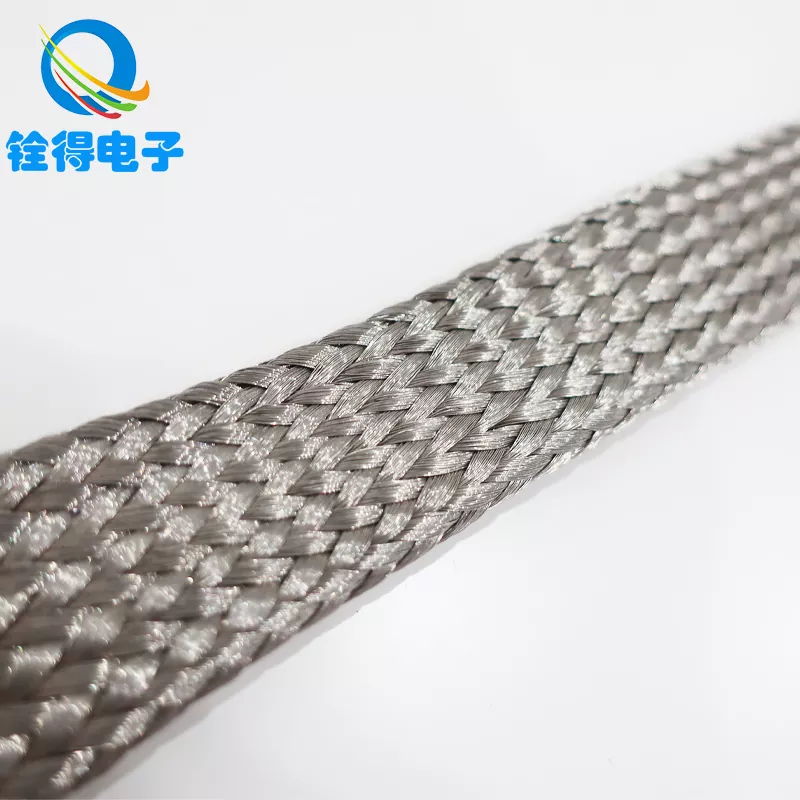
Nickel-Plated Copper Flat Braided Wire
China Nickel-Plated Copper Flat Braided Wire from Quande factory is used as a conductor and is braided into a belt shape by a braiding machine. During the braiding process, the braiding density and uniformity need to be adjusted according to the needs to ensure the strength and conductivity of the braided belt. After the braiding is completed, the braided belt is shaped and flattened to make its shape meet the customer's requirements.
Round Solid Flexible Braided Wire
Quande Electronics specializes in producing round solid flexible braided wires. The round solid flexible braided wires sold directly by the manufacturer are round braided wires made of fine copper wires. Compared with hollow wires, they are less prone to damage and more durable.
Flat Tinned Copper Braid
Flat tinned copper braid is a product made of copper wire woven into a flat shape and tinned on the surface. It has good conductivity, corrosion resistance and flexibility, and is often used in electrical equipment connection, grounding system and electromagnetic shielding. Quande Electronics uses high-quality raw material oxygen-free copper wire and weaves it with a high-speed braiding machine. The product surface is free of cuts and burrs.
Copper Flexible Connecting Wire
Copper Flexible Connecting Wire is a high current conductor used to achieve flexible conductive connection between electrical equipment. It has many advantages and is widely used. Copper braided wire flexible connector: It is braided from multiple strands of copper wire, has good flexibility, and can be made into different shapes and sizes as needed.
1.5MM Solder Wick Braid Wire
The 1.5MM Solder Wick Braid Wire is a tool used to remove excess solder from electronic components such as circuit boards. The tin-absorbing copper braid is mainly woven from copper wire. The pure copper tin-absorbing copper braid has good electrical and thermal conductivity, and can quickly transfer heat to melt and absorb the solder. Quande Electronics is constantly pursuing innovation and improvement, using advanced technology and processes to improve product quality, so that it always leads its peers.
- Related Blog
- Reviews

Send Inquiry


X
We use cookies to offer you a better browsing experience, analyze site traffic and personalize content. By using this site, you agree to our use of cookies.
Privacy Policy